The quality of a piping system depends heavily on the material selected for pipes and fittings. In drinking-water distribution, clean-water processing, precision manufacturing, and chemical fluid handling, the piping material must do more than withstand internal pressure. It must maintain dimensional stability, resist corrosion, protect fluid quality, tolerate temperature changes, and provide reliable joints throughout its service life.
Environmental performance has also become increasingly important. Modern pipe systems are expected to reduce material consumption, energy requirements, installation time, maintenance frequency, and waste while maintaining mechanical reliability. This has encouraged engineers and procurement teams to evaluate advanced polymeric materials not only by their initial purchase price but also by their complete lifecycle performance.
AGR piping is presented in the supplied material as an environmentally oriented pipe-and-fitting system with a combination of low-temperature resistance, impact strength, rigidity, pressure resistance, smooth internal surfaces, low oxygen permeability, reliable adhesive connections, and recyclability. These characteristics make the material particularly relevant to applications where water cleanliness, installation reliability, and long-term mechanical performance must be considered together.
For professional users, however, material selection should always be based on verified product standards, certified test data, actual operating conditions, and local regulatory requirements. A material described as suitable for drinking water in one market should not automatically be assumed to satisfy every jurisdiction's potable-water approval requirements.
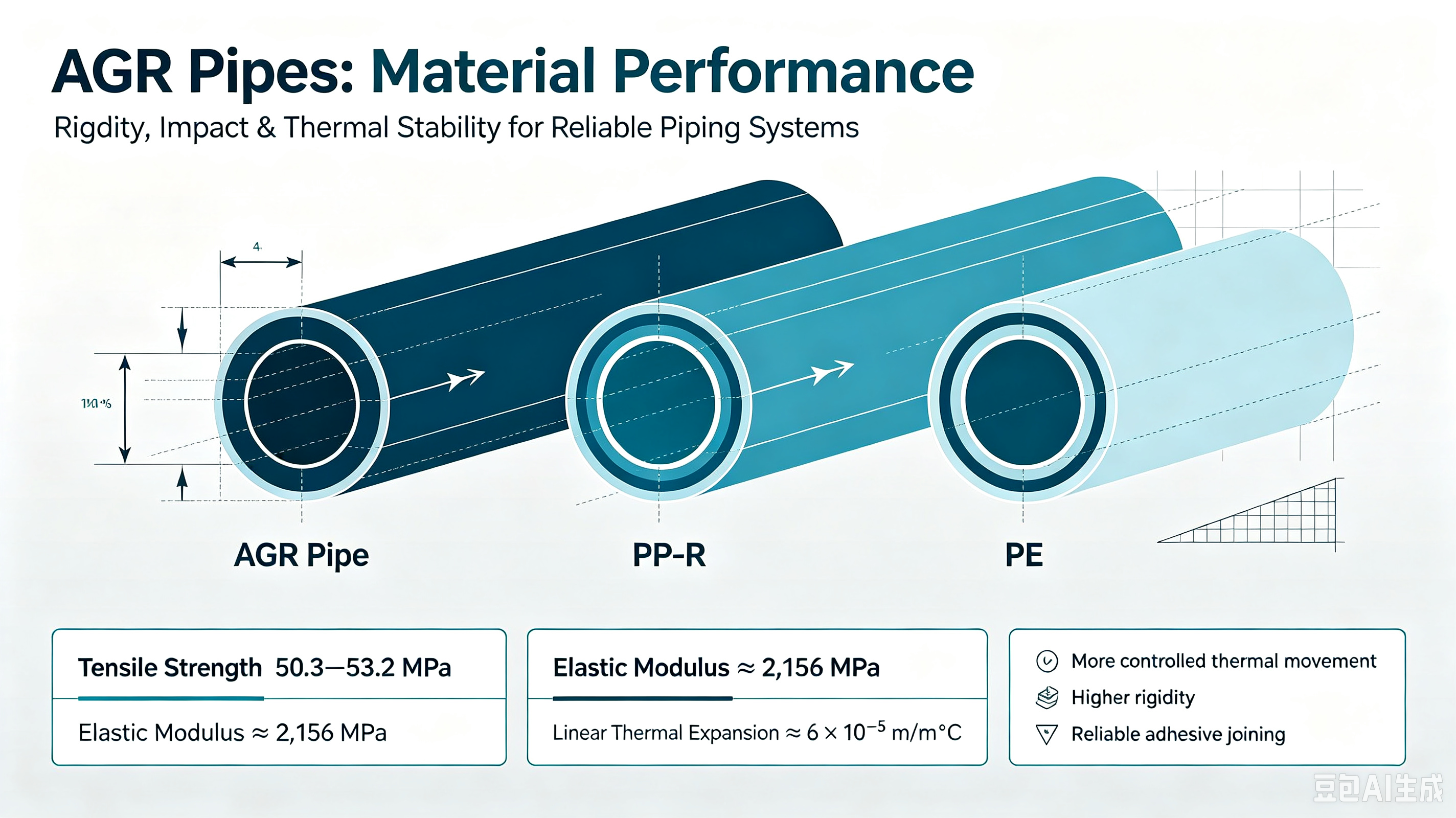
AGR belongs to the family of engineered polymer piping materials, but the performance characteristics described in the source material distinguish it from more conventional plastic piping systems such as PP-R and PE. The supplied data identify a tensile strength of approximately 50.3–53.2 MPa, an elastic modulus of about 2,156 MPa, and a linear thermal expansion coefficient of approximately 6 × 10⁻⁵ m/m·°C.
These values indicate a relatively rigid material with comparatively controlled thermal movement. For piping engineers, this matters because polymer systems generally have greater thermal expansion than metals. Excessive movement can create stresses at supports, connections, equipment nozzles, and changes in direction.
A pipe material with higher stiffness and a lower coefficient of linear expansion can therefore simplify support design and reduce the amount of thermal movement that needs to be accommodated. This does not eliminate the need for expansion analysis, but it can improve dimensional stability in both exposed and concealed installations.
The source material also emphasizes that AGR pipe walls can be thinner than those of some PP-R or PE systems under comparable pressure requirements. A thinner wall can potentially reduce material consumption and make installation easier, provided that the pipe remains fully compliant with the applicable pressure, temperature, dimensional, and safety requirements.
Environmental performance in piping should not be evaluated only by whether a material can technically be recycled. The amount of raw material used, manufacturing energy, transportation weight, installation requirements, service life, maintenance frequency, and end-of-life treatment all contribute to the overall environmental footprint.
If a higher-strength pipe can achieve the required hydraulic and pressure performance with a thinner wall, less polymer may be required for a given installation. Lower material consumption can reduce the mass transported to the construction site and potentially decrease installation effort.
However, wall thickness should never be reduced simply to achieve material savings. Professional design must establish the required pressure rating and structural performance first. Material efficiency should be the result of engineering optimization rather than under-specification.
A durable pipe can provide environmental advantages because replacement requires additional raw materials, transportation, labor, energy, and disposal. Corrosion-resistant polymer piping can be particularly attractive in applications where conventional metallic systems would require significant corrosion protection or eventual replacement.
Long-term service life also reduces operational disruption. In water-treatment plants, food-processing facilities, electronics manufacturing, and chemical plants, unplanned pipe replacement can affect production as well as maintenance resources.
Therefore, lifecycle durability should be considered alongside initial cost when evaluating sustainable piping systems.
One of the important characteristics attributed to AGR pipe is its smooth internal surface. A smooth bore can reduce hydraulic resistance compared with rougher internal surfaces, particularly where deposits or corrosion products accumulate inside the pipe.
In general fluid-flow analysis, pressure loss depends on factors including pipe diameter, length, flow velocity, fluid properties, and internal surface characteristics. The Darcy-Weisbach equation is commonly used for estimating frictional pressure loss:
ΔP = f × (L/D) × (ρv²/2)
where f is the Darcy friction factor, L is pipe length, D is internal diameter, ρ is fluid density, and v is average flow velocity.
Internal roughness affects the friction factor. A smoother surface can therefore contribute to lower friction losses under appropriate flow conditions.
For water distribution systems, this can provide an opportunity to optimize pump selection and operating energy. Nevertheless, engineers should calculate actual hydraulic performance rather than assuming that every smooth polymer pipe automatically provides the same energy savings.
The supplied material states that AGR's smooth internal wall reduces the tendency for deposits to accumulate. This is important in water systems because mineral deposits, corrosion products, suspended solids, and biological growth can progressively reduce the effective flow area.
The relationship between deposit formation and water quality is complex. Pipe material is only one factor. Water chemistry, temperature, disinfectant concentration, stagnation time, nutrient availability, flow velocity, and system cleanliness also influence microbial and deposit behavior.
A smooth, chemically appropriate pipe can nevertheless provide a favorable foundation for maintaining a clean hydraulic pathway.
The source material identifies very low oxygen permeability as a significant AGR characteristic and states that its oxygen transmission rate is approximately 1/13 to 1/15 that of PP-R and PE materials. This claim should be interpreted as a product-specific performance statement that requires verification against the relevant test method and comparable material grades.
Low oxygen permeability can be valuable in closed fluid systems where oxygen ingress needs to be minimized. Oxygen entering a piping system can influence corrosion processes, chemical stability, and microbiological conditions depending on the application.
In drinking-water distribution, however, microbial safety cannot be determined from oxygen permeability alone. A complete assessment should include regulatory certification, extractables and leachables testing, disinfectant compatibility, biofilm behavior, and actual water-quality requirements.
The supplied material describes AGR as suitable for clean drinking-water applications and references World Health Organization and Chinese health requirements. In professional procurement, these statements should be supported by current, product-specific certification.
Depending on the market, potable-water piping may need to comply with national or regional requirements governing materials that come into contact with drinking water. In the United States, for example, specifications may involve NSF/ANSI/CAN 61 or other applicable requirements, while European projects may reference different national or European conformity systems.
Therefore, a purchaser should request:
- Current potable-water certification
- Applicable material standard
- Test reports
- Chemical-resistance information
- Temperature limitations
- Pressure ratings
- Installation requirements
- Approved joining materials
- Regulatory documentation for the intended market
This approach is more reliable than relying on a general statement that a pipe is “food grade” or “environmentally friendly.”
The supplied material states that AGR piping can operate in environments as cold as approximately −30°C and highlights its high impact resistance at low temperatures.
Low-temperature performance is important because many polymers become less ductile as temperature decreases. A material that performs well at ambient temperature may become significantly more susceptible to cracking during transportation, installation, accidental impact, or freezing conditions.
This is especially relevant to outdoor piping, northern climates, refrigerated facilities, construction sites, and exposed utility systems.
However, operating-temperature capability and impact-temperature capability should be distinguished. A material's ability to withstand an impact at a particular temperature does not automatically mean that it is suitable for continuous operation at the same temperature.
The source material gives specific impact-test examples. At −10°C, a 20 × 2.3 mm pipe is described as withstanding a 6 kg weight dropped from 0.8 m without cracking, while pipes with nominal diameters of 40 mm and above are described as withstanding a 9 kg weight dropped from 2.0 m.
These figures illustrate why impact resistance can be valuable during transportation and construction. Pipe sections may be exposed to accidental drops, rough handling, construction equipment, or localized impacts.
For engineering purposes, such values should be associated with a defined test standard, specimen geometry, conditioning procedure, impactor design, and acceptance criterion. Without the corresponding test method, individual impact numbers should not be directly compared across different pipe materials.
The reported AGR tensile strength of 50.3–53.2 MPa and elastic modulus of approximately 2,156 MPa indicate a relatively stiff polymeric material.
Elastic modulus describes the relationship between stress and elastic strain. A higher modulus generally means that a material undergoes less elastic deformation under the same stress, all else being equal.
For piping applications, stiffness influences:
- Support spacing
- Deflection
- Thermal movement
- External loading
- Installation stability
- Resistance to deformation
- Buried-pipe behavior
The actual design response depends on pipe geometry as well as material properties. A high material modulus does not eliminate the need to consider wall thickness, diameter, pressure, support conditions, and external loads.
The supplied linear expansion coefficient of approximately 6 × 10⁻⁵ m/m·°C is another important characteristic.
Thermal expansion can be estimated using:
ΔL = α × L × ΔT
where α is the coefficient of linear thermal expansion, L is the original pipe length, and ΔT is the temperature change.
For example, a long exposed pipe can experience measurable dimensional movement when ambient temperature changes substantially. Lower thermal expansion can reduce this movement and simplify support arrangements.
Nevertheless, the coefficient is not zero. Long pipe runs should still be designed with appropriate supports, anchors, guides, offsets, expansion loops, or other movement-control strategies where required.
A pressure pipe must maintain structural integrity against hoop stress, axial stress, joint loads, temperature effects, and external mechanical loads.
For a simplified thin-wall cylindrical model, circumferential stress can be approximated by:
σₕ ≈ P × D / (2t)
where P is internal pressure, D is pipe diameter, and t is wall thickness.
This relationship illustrates why material strength and wall thickness are fundamental to pressure-pipe design. If the material has sufficient strength and stiffness, an optimized wall thickness may achieve the required pressure performance without unnecessarily increasing material consumption.
In actual polymer pipe design, engineers must account for long-term creep, temperature-dependent strength, safety factors, manufacturing tolerances, and applicable pipe standards. Short-term tensile strength alone is not sufficient for establishing a pipe's long-term pressure rating.
Polymers behave differently from metals under sustained load. At constant stress, polymer materials can undergo creep, meaning gradual deformation over time.
This is particularly important in pressure piping because internal pressure produces continuous circumferential stress. Temperature can accelerate creep, while material formulation and processing history can significantly influence long-term performance.
Professional specifications should therefore use long-term hydrostatic strength or equivalent standardized pressure-performance data rather than calculating service life solely from short-term tensile strength.
A pipe system is only as reliable as its connections. Even if the pipe itself has excellent pressure and chemical resistance, an improperly prepared joint can become the weakest point in the installation.
The supplied AGR system uses a dedicated No. 80 adhesive described as having strong affinity with AGR resin and rapid curing characteristics. Adhesive joining can provide several installation advantages, including relatively simple equipment requirements, convenient connection geometry, and the ability to create continuous contact between pipe and fitting.
The quality of an adhesive joint depends on more than adhesive selection. Surface preparation, pipe cutting, insertion depth, environmental conditions, curing time, adhesive storage, application quantity, and installer technique can all affect joint performance.
A professional installation process may include:
- Cut the pipe squarely.
- Remove burrs and clean the pipe end.
- Verify the fitting and pipe dimensions.
- Prepare the joining surfaces according to the manufacturer's instructions.
- Apply the approved adhesive uniformly.
- Insert the pipe to the specified depth.
- Hold the assembly in position during initial setting.
- Allow the joint to cure for the specified time.
- Inspect the connection before pressure testing.
- Conduct the required hydraulic or leak test.
The exact procedure should always follow the manufacturer's installation documentation and the applicable standard.
The source material reports that burst-pressure testing of AGR pipe-and-fitting assemblies resulted in failures occurring in the pipe rather than at the bonded joint.
If verified under an appropriate standardized test method, this type of failure pattern is useful because it indicates that the joint may have a strength comparable to or greater than the tested pipe section.
However, a burst test represents a specific short-term failure condition. It does not by itself establish decades of service life. Long-term hydrostatic testing, thermal cycling, chemical exposure, pressure cycling, and joint aging may also be relevant depending on the application.
The supplied material also describes a repeated bending test in which joints were subjected to ±4° movement under 17.5 kg static water pressure for more than 2,000 cycles without leakage or separation.
This is particularly relevant because piping systems can experience movement caused by thermal expansion, vibration, equipment operation, pressure fluctuations, and installation tolerances.
The engineering significance of such a result depends on the exact test conditions and standard. Still, it demonstrates the importance of evaluating a connection under combined mechanical and hydraulic loading rather than relying exclusively on static tensile or burst testing.
Drinking-water distribution systems frequently use disinfectants such as chlorine or chloramine. These chemicals are important for microbiological control but can interact with certain polymeric materials over long periods.
The source material states that AGR is not affected by residual chlorine and contrasts this with certain polyolefin materials such as PP, PE, and PB. Long-term polymer degradation is indeed a recognized consideration in the selection of plastic piping for chlorinated-water environments, but resistance varies substantially by resin formulation, antioxidant package, temperature, disinfectant concentration, and exposure duration.
Consequently, material comparisons should be based on standardized long-term chlorine-resistance data rather than broad statements about an entire polymer family.
A professional specification should identify:
- Free chlorine concentration
- Chloramine exposure
- Water temperature
- pH
- Exposure duration
- Pressure
- Flow conditions
- Cleaning and disinfection procedures
For high-temperature or chemically aggressive applications, accelerated aging tests and manufacturer-specific compatibility data may be particularly important.
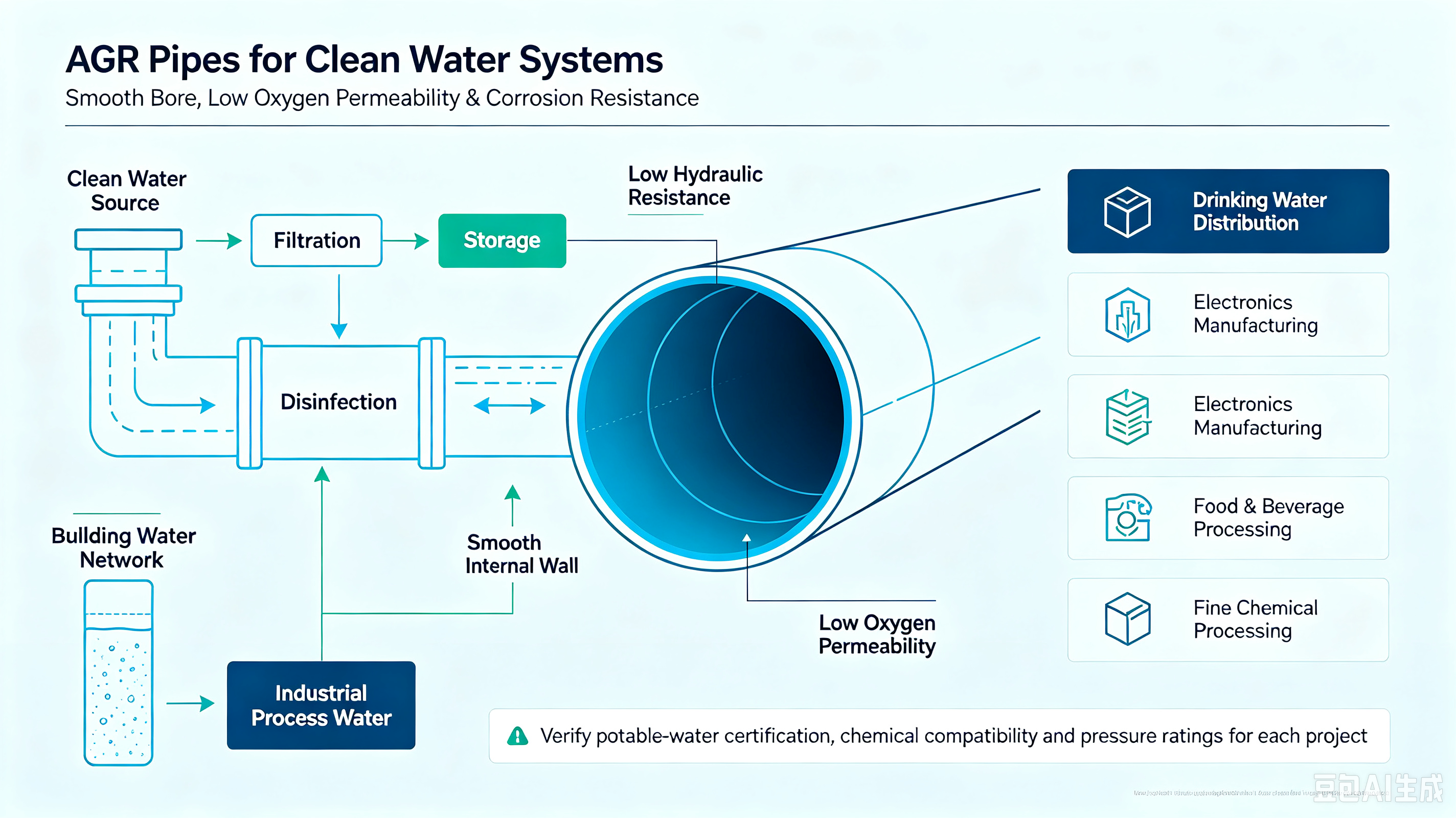
The combination of smooth internal surfaces, corrosion resistance, low oxygen permeability, impact resistance, and adhesive joining makes AGR relevant to certain drinking-water distribution applications.
Potential uses include building water systems, clean-water networks, and other potable-water installations where the material has the required regulatory approvals.
The system should be designed so that stagnation, dead legs, improper disinfection, temperature excursions, and contamination during installation are controlled. Pipe material alone cannot guarantee drinking-water quality.
Semiconductor, electronics, and precision-manufacturing facilities often require highly controlled water systems. Depending on the process, water may need to meet stringent requirements for particles, dissolved ions, organic contamination, and microbiological content.
The supplied material identifies AGR for clean-water systems in the electronics industry. For such applications, engineers should additionally evaluate extractables, ionic contamination, surface cleanliness, joint materials, flushing procedures, and compatibility with the required water-quality specification.
Beverage, brewing, and food-processing systems require careful consideration of hygiene and material compatibility. Pipes and fittings in contact with process fluids must be appropriate for the fluid composition, temperature, cleaning agents, and sanitation procedures.
AGR may be considered where its verified chemical resistance and hygienic certifications match the application. The specific service conditions remain decisive.
Chemical-processing applications can expose pipe systems to acids, alkalis, solvents, oxidizing agents, and mixed chemical streams.
A material described as corrosion-resistant should not be assumed to resist every chemical. Compatibility should be checked against concentration, temperature, exposure duration, pressure, and stress conditions.
For critical chemical service, manufacturers should provide chemical-resistance charts and preferably application-specific technical guidance.
| Performance consideration | AGR | PP-R | PE |
|---|
| Corrosion resistance | High for suitable services | High | High |
| Internal surface | Smooth | Smooth | Smooth |
| Low-temperature impact | Highlighted in supplied data | Grade dependent | Generally good, grade dependent |
| Rigidity | Relatively high according to supplied data | Grade dependent | Generally more flexible |
| Thermal movement | Relatively controlled according to supplied data | Requires consideration | Requires significant consideration |
| Joining method | Adhesive system described | Commonly heat fusion | Commonly fusion/electrofusion |
| Oxygen permeability | Reported as very low | Higher according to supplied comparison | Higher according to supplied comparison |
| Potable-water suitability | Requires market-specific certification | Requires certification | Requires certification |
| Chemical resistance | Application dependent | Generally good for many chemicals | Generally good for many chemicals |
| Long-term pressure design | Requires verified product data | Requires verified product data | Requires verified product data |
This table should be treated as an engineering comparison framework rather than a universal ranking. PP-R and PE encompass many grades with different formulations and standards, while AGR performance depends on the specific product construction and certification.
Installation Efficiency and Lifecycle Maintenance
The relatively high rigidity described for AGR can reduce the number of supports needed in some installations compared with more flexible plastic systems. Fewer supports can simplify construction and potentially reduce labor and component costs.
However, support spacing must always follow manufacturer instructions and applicable engineering requirements. Pipe diameter, temperature, fluid density, insulation, orientation, pressure, and support configuration can all influence allowable spacing.
Easier Maintenance
An efficient piping system should be designed for the entire lifecycle rather than only the installation phase.
Maintenance planning should consider:
- Accessibility of valves and fittings
- Isolation points
- Drainage
- Inspection access
- Replacement procedures
- Pressure-test points
- Cleaning and flushing
- Identification and labeling
- Spare-parts availability
A reliable joining system can reduce leakage risks, while a standardized fitting range can make future modifications easier.
Pipe performance begins with raw-material quality. Resin composition, stabilizers, processing aids, pigments, and other additives influence mechanical strength, chemical resistance, thermal stability, and long-term aging.
For potable-water applications, additive selection is particularly important because substances capable of migrating into water must be controlled.
Manufacturers should maintain traceability from raw material through extrusion, fitting production, inspection, and packaging.
During pipe extrusion, process temperature, screw speed, cooling conditions, wall thickness, ovality, and dimensional control must be carefully managed.
Potential manufacturing defects include:
- Uneven wall thickness
- Surface defects
- Voids
- Inclusions
- Poor dimensional control
- Residual stresses
- Insufficient fusion or molding quality in fittings
Quality-control systems should combine dimensional inspection with mechanical and pressure testing according to the applicable product standard.
Before specifying an AGR pipe-and-fitting system for a major project, procurement teams should request technical documentation covering the intended application.
A useful documentation package may include:
- Product datasheets
- Material specifications
- Pressure-temperature ratings
- Dimensional standards
- Impact-resistance test reports
- Hydrostatic-pressure test data
- Chemical-resistance information
- Adhesive specifications
- Joint-strength test results
- Potable-water certification where applicable
- Installation manuals
- Quality-management certification
- Traceability documentation
- Warranty and service-life information
This documentation helps transform a material claim into an engineering decision supported by measurable evidence.
Energy efficiency in water systems is closely related to pressure loss. A pipe with an appropriately sized smooth bore can reduce frictional losses and potentially reduce pump energy consumption.
However, oversizing a pipe also has disadvantages, including higher material cost, greater water volume, and potentially lower flow velocity. The optimal pipe diameter should therefore balance capital expenditure, hydraulic efficiency, pump energy, and operating requirements.
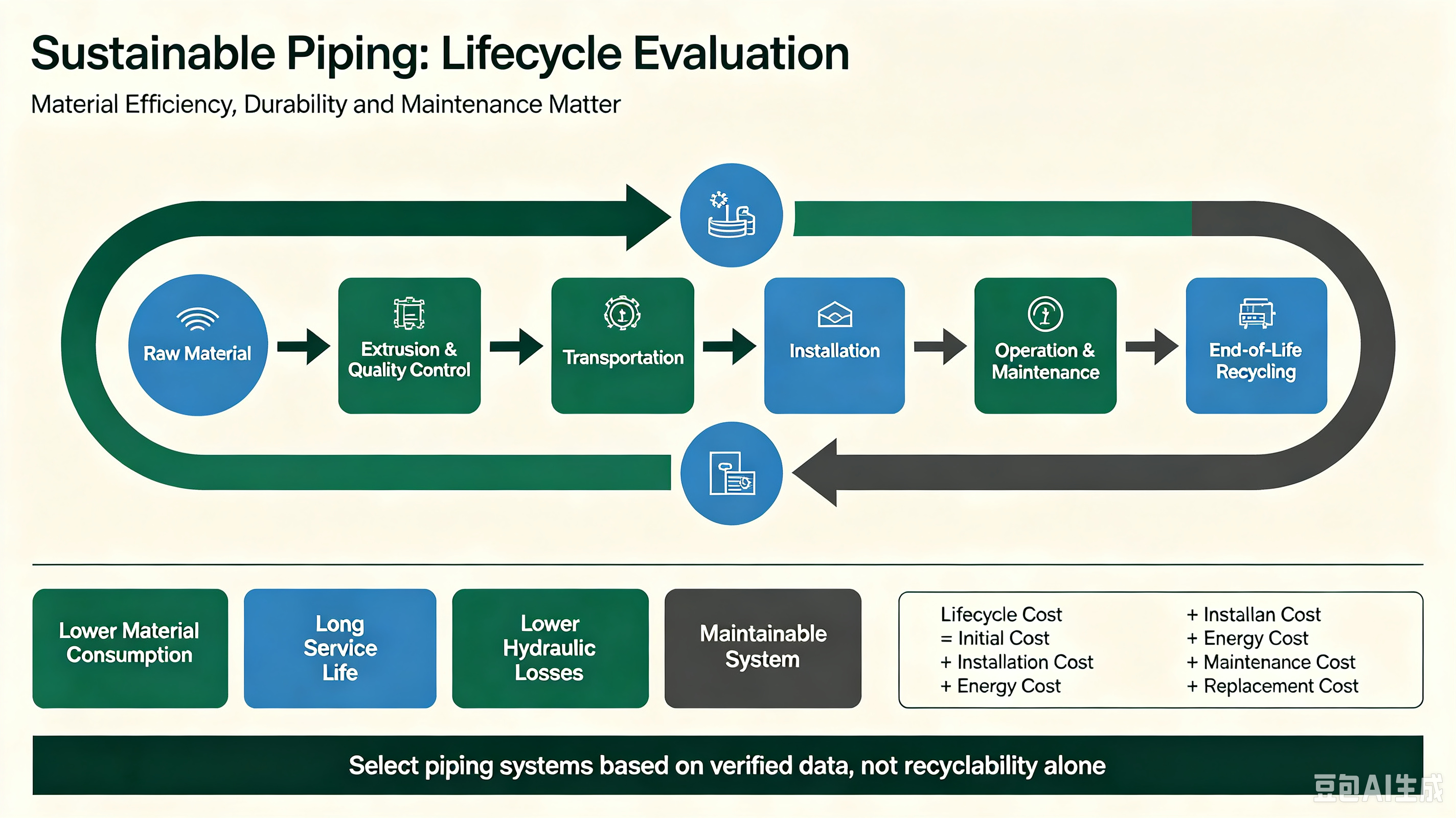
Engineers can evaluate the total lifecycle cost using:
Lifecycle Cost = Initial Cost + Installation Cost + Energy Cost + Maintenance Cost + Replacement Cost
This framework provides a more meaningful comparison than purchase price alone.
For a pumping system, hydraulic power can be approximated as:
P = ρgQH / η
where ρ is fluid density, g is gravitational acceleration, Q is flow rate, H is total head, and η represents overall pump and drive efficiency.
Reducing unnecessary frictional head loss can reduce the required pumping head. Over thousands of operating hours, even a modest reduction in hydraulic losses may have significant energy implications.
The supplied material identifies recyclability as one of AGR's environmental characteristics. Recycling can reduce demand for virgin raw materials when suitable collection and processing systems are available.
Actual recyclability depends on material composition, contamination, additives, local recycling infrastructure, and whether different polymer families have been mixed.
For industrial facilities, waste segregation at the installation site can improve the feasibility of recovering clean offcuts and unused material.
Sustainable pipe procurement can include several strategies:
- Minimize unnecessary wall thickness
- Optimize pipe diameter
- Reduce installation waste
- Use durable materials
- Maintain traceability
- Separate recyclable waste
- Avoid incompatible material mixtures
- Design for repair where practical
- Extend service life through correct installation
This approach places sustainability within the entire lifecycle of the piping system rather than treating it as a marketing characteristic.
A structured selection process helps engineers determine whether an AGR system is appropriate.
Define the fluid, pressure, temperature, flow rate, concentration, disinfectant exposure, and expected operating cycle.
For drinking water or food-contact applications, identify the exact certification requirements of the installation country or region.
Review pressure ratings, long-term hydrostatic strength, impact resistance, tensile properties, elastic modulus, and temperature limitations.
Check the material against the actual process fluid rather than relying on generic descriptions such as “corrosion resistant.”
Verify the approved adhesive, curing conditions, joint preparation procedure, pressure-testing requirements, and installer qualifications.
Compare material cost, labor, support requirements, hydraulic performance, energy consumption, maintenance, expected service life, and replacement requirements.
For large projects, manufacturers should demonstrate consistent production quality, batch traceability, dimensional control, and technical support.
The development of piping materials is increasingly moving toward a combination of mechanical performance, environmental efficiency, hygiene, digital traceability, and lifecycle optimization.
Future pipe systems are likely to incorporate improved polymer formulations, more precise extrusion processes, better joining technologies, advanced testing methods, and increasingly comprehensive digital product documentation.
Manufacturers may also use lifecycle assessment to quantify carbon emissions from raw-material production through transportation, installation, operation, and end-of-life recycling.
For engineering companies, this creates a shift from asking simply, “Which pipe is cheapest?” toward a broader question: “Which piping system delivers the required performance with the lowest total lifecycle impact?”
AGR-type materials can be evaluated within this framework because their claimed advantages extend across several dimensions: mechanical performance, low-temperature durability, hydraulic characteristics, connection reliability, corrosion resistance, installation efficiency, and potential recyclability.
Environmentally oriented pipe and fitting materials are becoming increasingly important as industrial users seek reliable performance together with lower resource consumption and easier maintenance. AGR piping, based on the supplied technical information, combines relatively high rigidity, strong impact resistance, pressure capability, smooth internal surfaces, low thermal expansion, low oxygen permeability, and adhesive joint technology.
Its reported tensile strength of approximately 50.3–53.2 MPa, elastic modulus of about 2,156 MPa, and linear expansion coefficient of approximately 6 × 10⁻⁵ m/m·°C provide useful indicators of its mechanical and dimensional characteristics. The reported low-temperature impact results and joint testing further highlight the importance of evaluating pipe systems under realistic mechanical conditions rather than relying only on nominal specifications.
The material's potential applications include drinking-water distribution, clean-water systems, electronics manufacturing, food and beverage processing, and selected chemical-fluid applications. Nevertheless, potable-water suitability, chemical resistance, pressure rating, long-term service life, and environmental claims should always be confirmed using current product-specific certification and standardized test data.
For manufacturers, suppliers, contractors, and engineering firms, the key lesson is that sustainable piping is not simply about choosing a recyclable polymer. A high-quality pipe system should minimize material use while maintaining pressure integrity, resist environmental and chemical degradation, provide reliable joints, reduce hydraulic losses, simplify installation, and remain maintainable throughout its service life.
When these factors are evaluated together, advanced pipe and fitting materials can contribute to cleaner water handling, more efficient installations, lower maintenance requirements, and more sustainable industrial infrastructure.